Quick start
Installation
pip install langgraph-jev
Set your API key (never commit it):
export TYPESAFE_API_KEY=...
The examples in examples/ also support a project-local .env file (already
covered by .gitignore) via optional python-dotenv support:
pip install "langgraph-jev[examples]"
echo "TYPESAFE_API_KEY=..." > .env
python examples/basic.py
Define a node
from langgraph_jev import JevNode, choice

jev = JevNode(
    questions={
        "route": choice(["coding", "support", "research"]),
    }
)
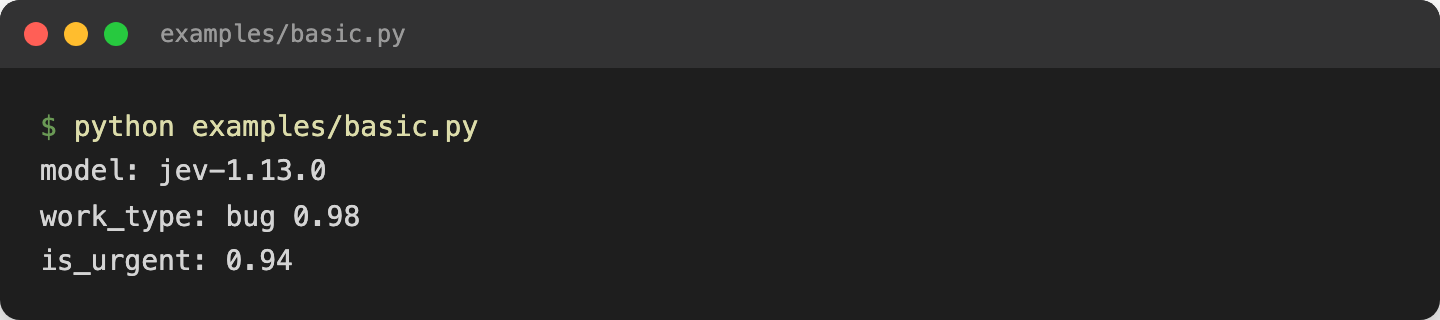
Running examples/basic.py against a real state produces typed decisions
with confidence scores, not free text:
Resource cleanup
JevClient (and anything built on it, like JevNode/JevRunnable) opens
underlying HTTP clients on construction. Close it when you're done, or use
it as a context manager:
from langgraph_jev import JevClient, choice

with JevClient() as client:
    result = client.decide(state={"title": "..."}, questions={"route": choice(["a", "b"])})

# or, in async code:
async with JevClient() as client:
    result = await client.adecide(state={"title": "..."}, questions={"route": choice(["a", "b"])})
If you construct a long-lived JevNode/JevRunnable (e.g. one per graph,
reused across requests), there's no need to close it per-call -- call
client.close()/await client.aclose() once when your application shuts
down.
Adding it to a LangGraph graph
JevNode is directly callable by LangGraph -- it receives graph state and
returns a state update (not a replacement of the whole state):
graph.add_node("jev", jev)
By default the entire graph state is passed to Jev as state. Use
state_key/output_key to scope input and output:
jev = JevNode(
    state_key="structured_request",
    output_key="decision",
    questions={...},
)
Confidence routing
Choice and Score answers include a confidence score derived from the
response's probability distribution (see
Confidence). Configure thresholds and
a policy for what happens below them:
jev = JevNode(
    questions={
        "work_type": choice(["bug", "support", "configuration", "documentation"]),
        "priority": choice(["critical", "high", "normal", "low"]),
    },
    thresholds={"work_type": 0.85, "priority": 0.90},
    low_confidence="human_review",  # "allow" (default) | "human_review" | "error"
)


def route_after_jev(state):
    if state["decision"].requires_review:
        return "human_review"
    return "continue"
Low-confidence decisions are never silently discarded -- the full decision and its confidence are always available on the result.
Routing helper
from langgraph_jev import route_by_decision


def route_work(state):
    return route_by_decision(
        state["decision"],
        field="work_type",
        routes={
            "bug": "coding_agent",
            "support": "support_agent",
            "documentation": "documentation_agent",
        },
        fallback="human_review",
    )
Jev makes the probabilistic decision; your application code decides what to do with it. Routing stays deterministic.
Using it as a LangChain Runnable
from langgraph_jev import JevRunnable, choice

jev = JevRunnable(questions={"route": choice(["coding", "support", "research"])})
result = jev.invoke({"title": "Customer cannot login"})
Supports both invoke() and ainvoke(), and goes through LangChain's
standard callback/tracing machinery (RunnableConfig, LangSmith, etc.).